

At a Glance:
What happens to a New York business when the owner dies without a plan?
In New York, a business interest is treated as personal property and must pass through the probate court unless otherwise structured. Without a plan that coordinates personal estate planning with corporate succession documents, the business may face an immediate liquidity crisis, frozen bank accounts, and legal disputes between surviving partners and heirs. Syncing these legal layers is the only way to ensure a seamless transfer of authority and protect the family’s financial interest.
Most business owners are “black belts” in strategy. You know how to manage cash, hire talent, and hedge risks. You probably have an accountant you trust and a lawyer who handles your contracts.
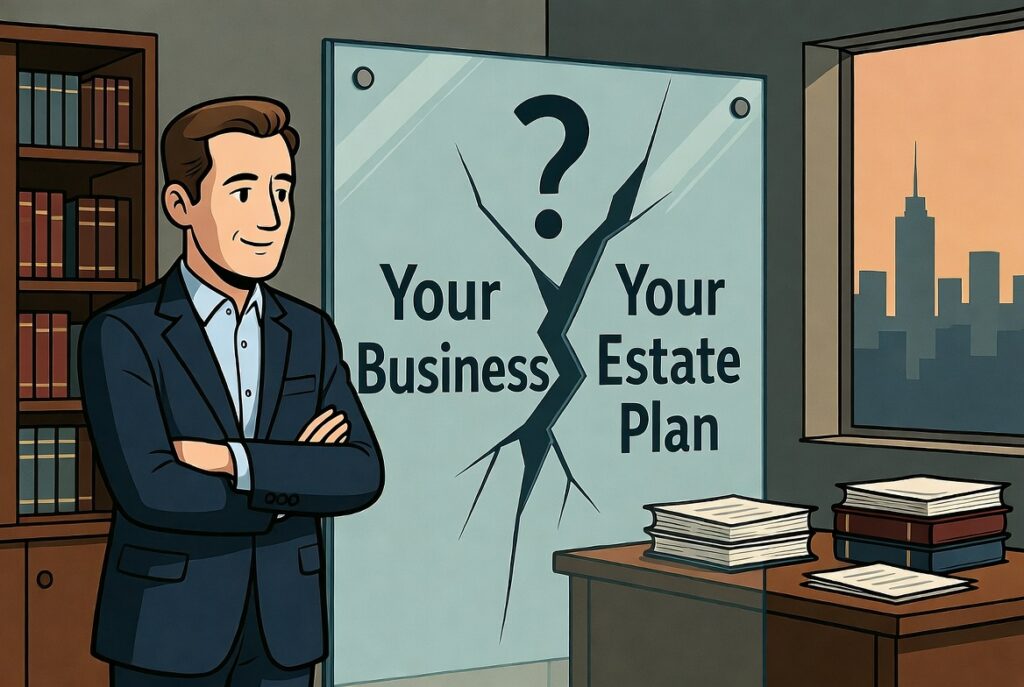
But here is the hard truth we see every day: Your personal estate planning and your business governing documents are likely on a collision course.
Usually, these files were written by different people at different times. They don’t talk to each other. When an owner dies, these two plans crash. That crash is loud, messy, and incredibly expensive for your family.
What Happens to a New York Business When the Owner Dies?
In New York, your business is “property,” just like your car or your house. If you don’t have a specific plan, it falls into a legal waiting room called Probate.
Think of the business like a high-end restaurant. If the owner dies and the “Legal Locks” get changed:
- The Staff: Who signs the payroll checks this Friday?
- The Clients: Do they stay, or do they flee to your rival because they’re scared the doors will close?
- The Family: Your spouse might suddenly “own” a company they don’t know how to run, but they still have to pay the bills.
If you are a Sole Proprietor, the business can literally evaporate in weeks. If you have Partners, your spouse might legally become their new, unwanted business partner. Imagine your husband or wife sitting in a board meeting they don’t understand, while your partners try to find a way to get them out.
The “Succession Trap”: Is Your Paperwork Lying to You?
Your Business Governing Documents (like an LLC Operating Agreement or a Corporate Shareholders’ Agreement) are the “Rulebook” for your company. They often contain a Buy-Sell Agreement, which says: “If I die, my partner buys my share, and the money goes to my family.” It sounds perfect. But most of them are “zombie” documents.
The $10 Million Gap: We see agreements signed in 2012 when the business was worth $1 million. Today, the business is worth $11 million. If you die tomorrow, your partner gets an $11 million company for a $1 million “discount” price. Your family just lost $10 million because of a 12-year-old piece of paper.
If you haven’t updated your business valuation in your governing documents in the last three years, your estate plan is a ticking time bomb.
Show Me the Money: Why Life Insurance Isn’t Enough
A Buy-Sell Agreement is just a piece of paper unless there is cash to back it up. Most partners use Life Insurance to fund the buyout. This is smart, but it’s often structured poorly.
If the “Tax Structure” is wrong, the surviving partner might get hit with a massive tax bill later, or the family might wait months for the check. Your personal estate planning needs to account for how this money is received, whether it goes into a trust to protect your spouse or directly to heirs who might not be ready for it.
Are You Handing Over a Job or an Investment?
You need to decide: Succession vs. Sale.
- Succession (The Family Legacy): If one child works in the business and the other doesn’t, is it fair to give them both 50%? (Hint: No. It’s a civil war waiting to happen.) We use personal estate planning tools to “equalize” the inheritance so the business kid gets the keys, and the other kid gets other assets of equal value.
- The Sale (The Exit): If your family is just going to sell the business, the plan should focus on “Key Person” protection. If the business depends entirely on your brain and your relationships, the value drops 80% the minute you’re gone.
What FreedomCounsel Does Differently
Most lawyers treat your business as a single line on a spreadsheet. They check the box and move on.
We don’t. At FreedomCounsel, we know your business is likely your biggest asset and your family’s biggest safety net. We don’t just draft a Will; we audit your Business Governing Documents, sync your Buy-Sell contracts, and talk to your CPA. We make sure the “Business You” and the “Family You” are on the same page.
Stop leaving your legacy to chance. Secure your peace of mind and protect your family’s future at freedomcounsel.co.